The IVO model doesn't try to prove anything.
It tries something far more human: to give language to experiences that until now had no language.
Not to explain what consciousness is, but to name what consciousness does.
Many people feel shifts in perception, direction, clarity, noise or synchronicity — but lack words to articulate them. And without words, experience is quickly seen as a problem, a deviation or personal failure.
IVO emerged as an answer to that gap.
As a way to make inner movements visible without pathologizing, mystifying or reducing them to theory.
It is not a worldview.
It is a map.
An interface between experience and understanding.
The name as structure, not as label
Long before there was a model, I knew my name felt different from a name. I·V·O behaved like three symbols, three building blocks.
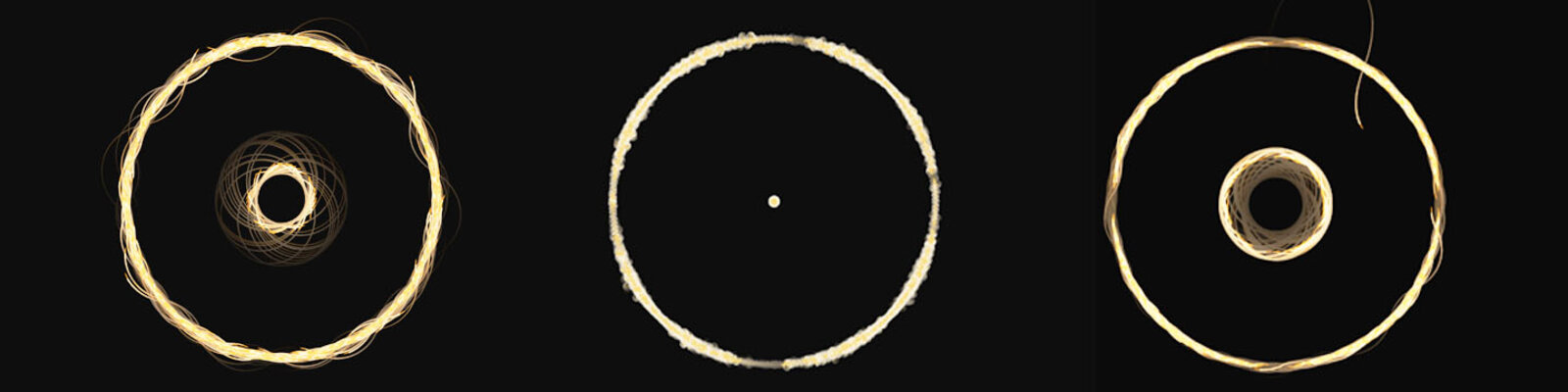
Years ago I made an animation showing which words, shapes and structures you can build from just those three characters. The logic was almost absurd. What then seemed like a curiosity later became a key: this was not a name, this was a structure.
At the time I still thought it was coincidence. Later I understood that I had a code in my hands.
When reality speaks louder than theory
Some insights don't arise because you think them up, but because reality forces you to look beyond any framework — beyond education, concepts and everything you thought you knew.
The IVO model emerged exactly like that: not as theory, but as an answer to experiences that were too precise, too reproducible and too functional to ignore.
Patterns that appeared everywhere
What began in me, I later saw everywhere.
I saw the same movements in people, in groups, in organizations, ecosystems, nature — even in astronomical and quantum phenomena. The same logic appeared everywhere.
Not as noise, but as information:
- shifts in feeling
- changes in direction
- subtle changes in interactions with environment
- moments of extreme clarity
- moments of chaos that wanted to show something
The world as mirror: too precise for coincidence
Again and again the outside world seemed to move along with my inner dynamics — as if something wanted to show how consciousness works.
It became impossible to keep seeing this as coincidence. It was too precise. Too consistent. Too directed.
The shift: consciousness as dynamic system
With that, one insight fell into place: consciousness is not a property of the brain, but a dynamic system that reveals itself through patterns — in people, in nature, in the world itself.
Why QBM didn't fit
Initially I called it QBM, the Quantum Consciousness Model. The link to quantum mechanics seemed logical.
But I quickly noticed that name pulled the conversation in the wrong direction. My work is not about matter, but about experience, direction, perception and field logic.
The model had to return to its essence. To simplicity. To the three building blocks that had been right in front of me all along: I — V — O.
My name turned out not to be a label, but a blueprint. Three functions that together form one system:
I
The Observer
V
Direction
O
The Field
Not because it had to be named after me, but because these three letters exactly capture how consciousness organizes itself.
And I knew, felt and know: this is right. No more reason is needed.
The IVO model is not a spiritual theory and not a scientific alternative. It is a functional consciousness instrument that makes three interconnected functions visible:
- a way of perceiving
- a way of moving or choosing
- a way the field responds to that movement
Together they show the underlying dynamics of consciousness:
- why some people perceive more clearly than they can explain
- why direction sometimes falls away or becomes compelling
- why flow arises or why noise intrudes
- why certain experiences dysregulate and others open
The model doesn't describe what you experience, but how consciousness moves.
And that was precisely what was always missing.
We live in a time when existing psychological and systemic models are becoming inadequate. Not because they're wrong, but because they were built for a worldview where consciousness was seen as individual, linear and mechanical.
But people experience:
- more sensitivity
- more directional shifts
- more field information
- more system pressure
- more layering
And have no language for it.
Reality now demands:
- insight
- clarity
- calm
- and above all: a language that matches what people actually experience and what reality itself reveals
The IVO model offers precisely that missing layer: the dynamics of consciousness.
The IVO model makes three essential functions of consciousness visible, so you can understand what moves in consciousness and how to work with it.
Three letters. Three functions. One system.
It was always there.
I just had to learn to see.